Bridging JAKIM Certification and Saudi SCoC Requirements
Malaysian SMEs treat JAKIM halal certification as a market-access credential for the Gulf. It is not. Saudi Arabia's Shipment Certificate of Conformity programme operates on a parallel technical track — and conflating the two produces shipments that are halal-certified, documentarily non-compliant, and detained at port.
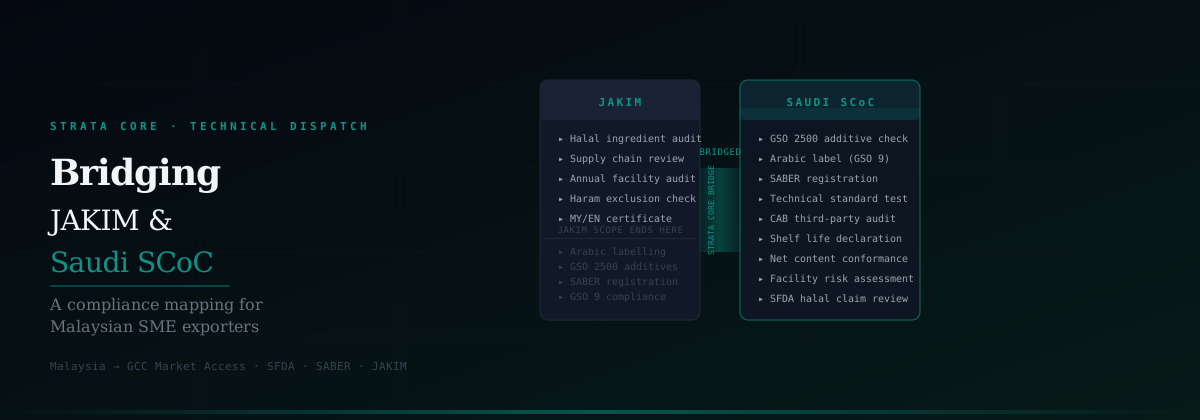
Two Frameworks, Two Different Questions
JAKIM — the Department of Islamic Development Malaysia — certifies that a product's inputs, manufacturing process, and handling chain conform to Islamic law as interpreted under Malaysian fatwa. Its primary question is theological and procedural: is the product halal? The Saudi Certificate of Conformity (SCoC), administered through SASO-accredited Conformity Assessment Bodies (CABs) under the Saudi Product Safety Program (Saleem), asks a structurally different question: does the product meet the technical requirements of the applicable Saudi or GSO standard?
These are non-overlapping inquiries. A product can satisfy both, either, or neither independently. The compliance failure mode that consistently affects Malaysian SME exporters is assuming the former implies the latter. It does not, and Saudi Customs Authority enforcement data makes this concrete: food and consumer goods shipments from Malaysia are among the top-five nationalities by rejection volume at King Abdulaziz Port, Dammam — with labelling non-conformance and missing SCoC documentation as the two primary cited grounds.
What the SCoC Programme Actually Requires
The Saleem programme mandates that regulated product categories arriving in Saudi Arabia carry a valid SCoC issued by a SASO-approved CAB before the shipment departs the country of origin. The SCoC is not a self-declaration — it requires a third-party conformity assessment against the applicable technical regulation. For food products, this means assessment against GSO standards (including GSO 2500 for food additives, GSO 9 for labelling, and category-specific GSO product standards). For consumer products, it means assessment against the relevant SASO technical regulation or its referenced IEC/ISO standard.
The SCoC must be registered in the SABER electronic platform before shipment. SABER is Saudi Arabia's product registration and conformity verification system — it cross-references the SCoC against the shipment's customs declaration at the border. A shipment that arrives without a SABER-registered SCoC for every regulated product line in the consignment is flagged for hold, regardless of what other documentation accompanies it.
Where JAKIM Certification Intersects — and Where It Stops
JAKIM certification is not without relevance to the Saudi market. Saudi importers and end-consumers expect halal-certified products, and JAKIM is among the halal certification bodies whose certificates are accepted by the Saudi Food and Drug Authority (SFDA) for halal claim substantiation on product labels. But this acceptance operates at the marketing claims layer — it permits a product to carry a halal logo and make halal assertions on its Saudi packaging. It does not substitute for, accelerate, or simplify SCoC issuance.
The compliance stack for a Malaysian food product entering Saudi Arabia therefore has three distinct layers, each with its own documentation, its own issuing authority, and its own verification system:
- Halal substantiation — JAKIM certificate, accepted by SFDA; supports halal label claims; renewed annually; product-formulation specific
- Technical conformity — SCoC issued by SASO-accredited CAB; registered in SABER; assessed against applicable GSO/SASO standard; required per shipment or product registration cycle
- Regulatory labelling compliance — Arabic label reviewed for GSO 9 conformance (mandatory Arabic text, net weight, country of origin, ingredients, additives, shelf life); separate from both JAKIM and SCoC but assessed as part of the CAB conformity review
Technical Divergence: JAKIM Scope vs. SCoC Assessment Scope
The table below maps the assessment scope of JAKIM certification against the SCoC conformity assessment for the same food product, illustrating where the two frameworks address the same variable and where they diverge entirely.
| Assessment Variable | JAKIM Halal Certification | SCoC / Saleem Programme | Overlap? |
|---|---|---|---|
| Ingredient halal status | Primary assessment criterion; full supply chain audit required | Not assessed; SFDA accepts JAKIM certificate for halal claims separately | None — parallel tracks |
| Food additive admissibility | Assessed for haram substances only (e.g., porcine-derived additives) | Assessed against GSO 2500 positive list; category and dose specific | Partial — different criteria |
| Arabic labelling | Not assessed; JAKIM certificate is in Bahasa Malaysia / English | Mandatory; assessed against GSO 9; CAB reviews Arabic label copy | None |
| Net content and fill | Not assessed | Assessed against applicable GSO product standard | None |
| Manufacturing facility audit | Annual on-site audit by JAKIM or approved certification body | Facility may be audited by CAB; depends on product risk category | Partial — different scope |
| Shelf life and storage claims | Not assessed | Assessed; must appear on label in conforming format | None |
| SABER platform registration | Not required; JAKIM issues paper/PDF certificate | Mandatory; SCoC must be registered in SABER before shipment | None |
TABLE 01 — Scope divergence between JAKIM halal certification and Saudi SCoC conformity assessment for food products. Seven of seven assessed variables show either no overlap or partial overlap with different criteria.
Technical Implementation: How Strata Core Maps the Gap
Dual-Framework Compliance Engine
Strata Core's Gulf Export module maintains separate compliance rulesets for halal substantiation requirements and SCoC technical conformity requirements, and executes them as independent assessment pipelines against the same product record. A product submitted for Saudi export screening receives two structured outputs: a JAKIM-to-SFDA halal documentation checklist and an SCoC readiness assessment against the applicable GSO standard. These are never merged into a single pass/fail output — the architectural separation reflects the legal separation of the frameworks.
SABER Readiness Scoring
Before a product record is flagged as export-ready, Strata Core's SABER readiness module verifies five preconditions:
- Applicable SASO product category and risk classification identified and confirmed
- SASO-accredited CAB assigned and SCoC application initiated
- Arabic label copy reviewed against GSO 9 field requirements
- GSO 2500 additive screening completed with no unresolved prohibited or conditionally permitted flags
- SABER product registration number generated and linked to shipment documentation
Document State Tracking Across Both Frameworks
JAKIM certificates and SCoC documents operate on different renewal cycles — JAKIM annually, SCoC by shipment or product registration period. Strata Core maintains a document state tracker that monitors expiry dates, flags renewal windows 90 and 30 days in advance, and blocks export readiness confirmation for any SKU where either document has lapsed. For Malaysian SMEs managing 20 to 200 active export SKUs across multiple GCC markets, this state-tracking function eliminates the category of compliance failure caused by expired documentation discovered at customs — which accounts for an estimated 30% of preventable shipment holds for Malaysian food exporters.
Strategic Verdict
The JAKIM-SCoC compliance gap is not a knowledge problem for Malaysian SMEs — most exporters with GCC experience know that both documents exist. It is a systems problem: the two frameworks are managed in separate organisational silos (typically the quality team owns JAKIM; the operations or logistics team owns shipping documentation), and no single system tracks the combined readiness state of both before a shipment is confirmed.
Three structural interventions close the gap operationally:
- Establish a unified per-SKU export readiness record that treats JAKIM certification status and SCoC registration status as co-equal preconditions — neither shipment confirmation nor proforma invoice generation should be possible until both are verified current
- Engage a SASO-accredited CAB at the product development or reformulation stage, not at the pre-shipment stage — late-stage SCoC applications that uncover GSO 2500 additive non-conformances require reformulation, not just documentation, and the lead time is measured in months
- Treat Arabic labelling as a technical compliance deliverable owned by the regulatory function, not a translation task owned by the marketing function — GSO 9 non-conformances are among the most common SCoC rejection grounds and the most preventable
A compliance platform that manages JAKIM and SCoC as a unified export readiness gate — rather than two separate document filing tasks — reduces the shipment hold rate for regulated product categories to near zero on documentation grounds. The remaining risk is formulation risk, which requires additive screening. Both are tractable data problems. Neither requires a shipment to fail before the gap becomes visible.