The Golden Window: Why Malaysian F&B and Cosmetics SMEs Should Move on Halal Exports Now
Malaysian halal exports just broke a record. GCC consumer demand is accelerating. Government funding is at its highest in a decade. The window where all three conditions coincide is open right now — and the manufacturers who move first will own the shelf positions, distributor relationships, and market registrations that define GCC access for the next decade.
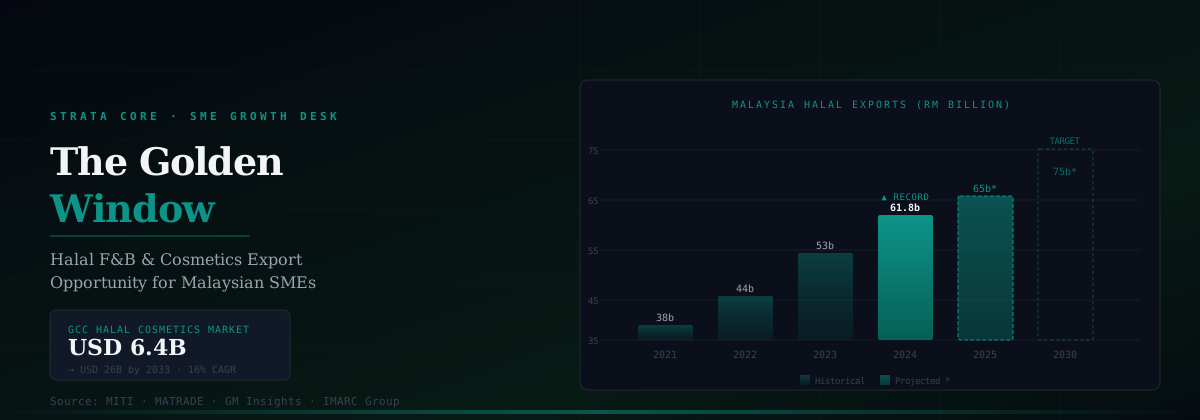
The Numbers Are Not Projections. They Are Already Happening.
Malaysia's halal product exports reached a record RM61.79 billion in 2024 — a 15% jump from RM53.72 billion in 2023, according to the Ministry of Investment, Trade and Industry (Malay Mail, May 2025). MATRADE projects RM65 billion in 2025, with the government's Halal Industry Master Plan targeting RM75.2 billion by 2030. The halal industry is on track to contribute RM231 billion — or 10.8% — to Malaysia's GDP within this decade.
These are not aspirational figures produced for government press releases. They reflect the purchasing decisions of 1.9 billion Muslim consumers globally — and a rapidly growing non-Muslim segment that chooses halal certification as a proxy for ingredient transparency and ethical production. In the GCC specifically, every major food and personal care category is expanding. The demand is structural, demographically driven, and not going away.
Your JAKIM Certification Is Worth More Than You Think
If you are JAKIM-certified, you are holding one of the most valuable market-access credentials in international trade and almost certainly under-deploying it. JAKIM's halal certification is recognised by over 80 foreign halal authorities across 45 countries — including the Saudi Food and Drug Authority (SFDA). This is not a given for halal certifiers from Indonesia, Thailand, or other competing export nations. When a Malaysian manufacturer walks into a GCC buyer meeting, the JAKIM logo accelerates distributor onboarding, satisfies retailer due diligence, and in Saudi government procurement contexts can be a qualifying criterion rather than just a differentiating factor.
The competitive advantage this creates is bankable and time-limited. As GCC markets mature and more exporting nations invest in internationally recognised halal certification, the first-mover premium for JAKIM-certified Malaysian manufacturers will compress. The manufacturers who establish distributor relationships, product registrations, and brand presence in Saudi Arabia, the UAE, and Kuwait in the next two to three years will hold structural advantages that later entrants will spend years and significant capital trying to displace.
Malaysian Brands That Proved It Works
The blueprint for GCC export success from Malaysia is not hypothetical — it has been demonstrated by Malaysian brands operating at multiple scales.
Founded in Melaka in 1971 as a family-run food company, Mamee now exports to over 80 countries including Bahrain, Kuwait, Oman, Qatar, and the UAE — all JAKIM-certified, all GCC-active. MATRADE's brand directory lists the full GCC country footprint. Mamee did not get there through superior product — it got there through sustained market development, JAKIM credibility, and compliant documentation at every shipment. The playbook is replicable.
The Johor Bahru-born QSR chain now operates in 16 countries including the UAE, Saudi Arabia, Bahrain, Qatar, and Kuwait. It built its GCC presence by treating halal certification not as a cost of compliance but as its primary brand positioning — and by securing the documentation stack (halal cert, local regulatory approvals, Arabic labelling) before entering each market, not after. The result: consistent shelf and outlet presence across all six GCC states.
Forty-seven Malaysian SMEs participated in MATRADE's structured export programme across a series of international trade events. Total export sales generated: RM240 million — against a target of RM47 million. That is a 5x overperformance, from SMEs, in a single programme cycle. The common denominator across all 47 participants: JAKIM-certified products, trade facilitation support, and compliant export documentation.
The GCC: Six Markets, One Unified Opportunity
The Gulf Cooperation Council is not a single market — it is six markets that share a common regulatory framework (GSO standards), a common currency dynamic (USD-pegged), and a common consumer preference for certified halal products. For Malaysian exporters, the strategic logic is compelling: establish compliant documentation once against GSO and SFDA requirements, and that documentation is substantially transferable across Saudi Arabia, UAE, Kuwait, Qatar, Bahrain, and Oman.
| Market | Population / Muslim % | Key Opportunity | Priority Segment | Tier |
|---|---|---|---|---|
| Saudi Arabia | 36M / 100% | Vision 2030 retail expansion; SFDA accepts JAKIM; largest GCC import volume | F&B, supplements, cosmetics | Tier 1 |
| UAE | 10M / 76% | Re-export hub; cosmopolitan consumer base; premium halal beauty demand; e-commerce gateway | Cosmetics, premium F&B, confectionery | Tier 1 |
| Kuwait | 4.5M / 74% | Highest per-capita income in GCC; strong branded product loyalty; repeat SKU retention | Processed F&B, personal care | Tier 2 |
| Qatar | 3M / 67% | Post-World Cup infrastructure boom; growing expat Muslim population; premium positioning | F&B, halal supplements | Tier 2 |
| Bahrain | 1.5M / 70% | Gateway to Saudi market; smaller volume but faster regulatory approval timelines | F&B, cosmetics | Tier 2 |
| Oman | 4.5M / 87% | Underpenetrated by Malaysian brands; growing modern trade; strong preference for imported F&B | Packaged F&B, personal care | Tier 2 |
TABLE 01 — GCC market prioritisation for Malaysian halal F&B and cosmetics manufacturers. Tier 1 markets offer highest combined demand volume, JAKIM acceptance, and accessible trade infrastructure. All six markets share GSO regulatory framework.
For cosmetics manufacturers specifically, the GCC halal beauty market reached USD 6.4 billion in 2024 and is projected to reach USD 26 billion by 2033 — a 16% CAGR driven by rising female workforce participation, a median population age under 30, and a premiumisation trend that explicitly favours certified, ingredient-transparent brands (IMARC Group). Malaysian cosmetics brands with JAKIM certification — including emerging names like Nurraysa, Simplysiti, and the dUck cosmetics line — are entering a market that is actively looking for exactly what they produce.
The Government Has Already Funded Your First Steps
You do not need to bear the full cost of GCC market entry alone. The following instruments are active right now and directly accessible to qualifying Malaysian SMEs:
- MATRADE Market Development Grant (MDG) — Covers international trade fair participation up to RM25,000 per event, overseas business matching missions, and listing fees. Lifetime cap raised to RM300,000 per company. Budget 2026 allocates RM60 million to this programme.
- EXIM Bank Exporter Sustainability Incentive — RM500 million in soft loans for export expansion under Budget 2026. Total EXIM Bank envelope raised to RM10 billion specifically to support Malaysian exporters navigating international markets.
- SME Bank Halal Financing + Jaguh Serantau — RM100 million dedicated halal SME financing, plus RM200 million specifically for Bumiputera SMEs entering export markets, both backed by RM2 billion in enhanced SJPP government guarantees.
- MIHAS International Platform — The Malaysia International Halal Showcase generated RM4.3 billion in sales at its 2024 edition. MIHAS now activates internationally in Dubai and Shanghai, with SME participation co-funded through MDG. This is direct B2B access to GCC buyers, category managers, and distributors — in a room where they are actively looking to buy.
- HDC Capacity Building — RM20 million allocated for halal industry development including international certification recognition, GCC market intelligence, and audit support under HIMP 2030.
The One Thing Stopping Most SMEs — And How to Remove It
The barrier is not demand, product quality, or JAKIM certification. Every Malaysian SME we speak to already knows the GCC opportunity exists. The barrier is the compliance documentation stack required for market entry — and the operational complexity of managing it across an active product portfolio while running a business.
To ship a regulated food product to Saudi Arabia, a Malaysian SME needs: a current JAKIM certificate, a Saudi Certificate of Conformity (SCoC) registered in the SABER platform, a GSO-compliant Arabic label reviewed against GSO 9, and a clean GSO 2500 additive screening result for every SKU. These four requirements are managed by different authorities, on different renewal cycles, with different documentation formats. Most SMEs do not have a dedicated regulatory affairs team to manage this. Most freight forwarders are not compliance specialists — they submit what the exporter provides. The first indication that something was wrong is a customs hold in Dammam or Abu Dhabi, at which point the financial exposure — demurrage, destruction, lost product value — routinely exceeds RM80,000 per container.
This is not an intractable problem. It is a data management and process problem, and it is exactly what Strata Core was built to solve.
Strata Core Gets You Export-Ready. Faster.
Our Sovereign AI compliance platform maps your product formulations against GSO 2500, screens your additive declarations, generates your SABER readiness report, and tracks your JAKIM and SCoC document cycles — all in one place, with zero data retention risk under Malaysian PDPA.
We work directly with Malaysian F&B and cosmetics manufacturers to build the compliance infrastructure that turns a GCC market opportunity into confirmed export revenue. The manufacturers we onboard now will hold the registrations, distributor relationships, and compliance history that define their market position for the next decade.
Growth Desk Verdict
The halal export opportunity for Malaysian F&B and cosmetics manufacturers is not emerging — it is active, funded, and being captured right now by the manufacturers who have solved their compliance documentation problem. Five conditions that rarely align are coinciding in 2025:
- Record Malaysian halal exports at RM61.79 billion and accelerating toward RM75 billion by 2030
- GCC halal cosmetics growing at 16% CAGR to a projected USD 26 billion market by 2033
- JAKIM certification accepted by SFDA — a trust credential competitors in other exporting nations cannot quickly replicate
- Government financing at its highest level in a decade across MDG, EXIM Bank, SME Bank, and HDC instruments
- Compliance tooling now available that resolves the documentation management barrier that has historically blocked SME market entry at the execution stage
The manufacturers who begin export compliance preparation and distributor engagement now will hold durable advantages. GCC markets do not offer easy re-entry to those who arrive late. The window is open. The question is whether you are going to be in it.