TECHNICAL DISPATCH
The GSO 2500 Additive Blacklist:
A Technical Mapping
A precise classification reference for Malaysian SME exporters navigating Gulf Cooperation Council food safety requirements — and the compliance architecture needed to enforce them programmatically.
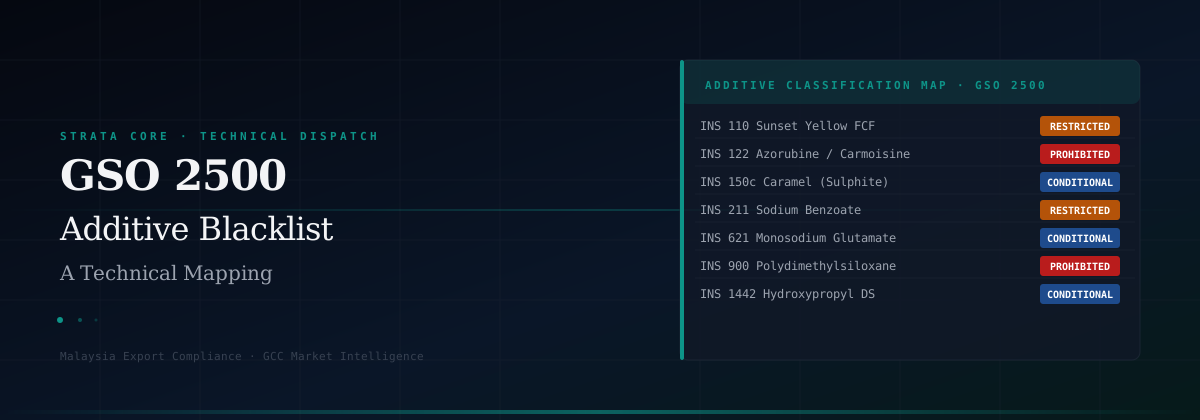
What GSO 2500 Actually Prohibits
GSO 2500, the GCC General Standard for Food Additives published by the Gulf Standards Organization, operates as a positive-list framework: any food additive not explicitly permitted is implicitly prohibited. This is architecturally different from Malaysia's Food Act 1983 and its Food Regulations 1985, which enumerate specific prohibitions but allow broader additive categories by class. Malaysian SMEs trained on domestic compliance logic frequently misread this inversion and incorrectly assume that an additive permissible under Malaysian law is admissible in GCC markets.
The practical consequence is a blacklist that is not a single enumerated table but a derived artifact — the set difference between what GSO 2500 permits and what a given product's formulation contains. Mapping this requires resolving three distinct data problems: additive identity (E-number vs. INS number vs. local trade name), category applicability (the permitted additive may be lawful only in specific food categories), and maximum use level (an additive may appear on both lists but at conflicting dose thresholds).
Malaysian SME-Specific Pain Points
01 — JAKIM Halal Certification Does Not Imply GSO Admissibility
A persistent compliance assumption among Malaysian food manufacturers — particularly in the processed food corridor stretching from Shah Alam to Batu Kawan — is that JAKIM halal certification provides a de facto clearance for GCC markets. It does not. Halal certification addresses slaughter method, haram substance exclusion, and cross-contamination controls. It is silent on synthetic colorants, preservative concentration limits, and the use of flavour enhancers such as INS 621 (monosodium glutamate) in categories where GSO 2500 imposes stricter thresholds than Malaysian regulations. A product can be fully JAKIM-certified and simultaneously non-admissible under GSO 2500.
02 — OEM and Contract Manufacturers Inherit Full Liability
Malaysian SMEs frequently operate as OEM producers for regional distributors. Under this model, the Malaysian factory's export documentation — specifically the Certificate of Free Sale issued by the Ministry of Health Malaysia — describes the product's compliance with Malaysian law, not GCC law. GCC customs authorities in Riyadh, Dubai, and Abu Dhabi conduct independent laboratory testing. When a shipment fails, the importer of record bears the immediate financial penalty, but reputational damage and delisting fall on the Malaysian producer. There is no liability transfer mechanism embedded in standard OEM contracts that insulates the factory.
03 — SME Formulation Opacity
Large Malaysian food conglomerates (Mamee-Double Decker, Spritzer, Gardenia) maintain dedicated regulatory affairs teams. SMEs operating below the RM 50 million revenue threshold typically do not. Formulation records are often held in a non-standardised state — ingredient specifications from multiple suppliers may use different nomenclature systems, and no single internal system resolves whether Carmoisine, Azorubine, and E122 refer to the same substance (they do). This nomenclature fragmentation is the single largest source of false-negative compliance results in pre-export audits.
Key Additive Categories: Divergence Mapping
The table below maps selected additive categories where Malaysia's Food Regulations 1985 and GSO 2500 produce materially different compliance outcomes for common Malaysian export product classes.
| Additive / INS | Common Malaysian Use | MY Status | GSO 2500 Status | Risk Flag |
|---|---|---|---|---|
INS 110 Sunset Yellow FCF |
Instant noodles, soft drinks, confectionery | Permitted (GMP) | Permitted in limited categories only; prohibited in infant food | Restricted |
INS 122 Azorubine (Carmoisine) |
Flavoured syrups, jelly, canned food | Permitted | Not listed in GCC positive list for most food categories | Prohibited |
INS 150c/d Caramel Colour (Sulphite/Ammonia) |
Soy sauce, dark beverages, seasonings | Permitted | 150c/d subject to 4-MEI limits not codified in MY regulations | Conditional |
INS 211 Sodium Benzoate |
Fruit drinks, sauces, pickles | Max 1000 mg/kg (beverages) | Max 500 mg/kg (carbonated beverages); category-specific | Restricted |
INS 621 Monosodium Glutamate |
Instant noodles, seasonings, snacks | GMP (no specified max) | Prohibited in food for infants and young children; GMP elsewhere | Conditional |
INS 900 Polydimethylsiloxane |
Cooking oils (anti-foaming) | Permitted up to 10 mg/kg | Not present in GSO 2500 positive list for refined oils | Prohibited |
INS 1442 Hydroxypropyl Distarch Phosphate |
Modified starch in sauces, dairy analogues | Permitted | Permitted; label declaration required as "modified starch" | Conditional |
TABLE 01 — Divergence map: MY Food Regulations 1985 vs. GSO 2500. Status reflects general food category defaults; category-specific exceptions exist. Last reviewed against GSO 2500:2022 Amendment 3.
Technical Implementation: How Strata Core Resolves the Mapping Problem
Additive Identity Resolution Engine
The first layer of Strata Core's GSO 2500 compliance module is a normalisation pipeline that resolves additive identity across six nomenclature systems: INS number, E-number, CAS registry number, INCI name, Malaysian MOH trade classification, and free-text supplier description. This is not a lookup table — it is a graph-based synonym resolver trained on regulatory corpora from Codex Alimentarius, EFSA, and GCC technical bulletins. A supplier SDS listing "FD&C Yellow 6" is resolved to INS 110 before any compliance check is executed.
Category-Applicability Inference
GSO 2500 uses the Codex food category system. The compliance determination for any additive is a three-variable function: f(additive_id, food_category, use_level). Strata Core's category inference engine accepts a product's ingredient declaration and, where provided, a product type descriptor, and emits a ranked list of probable Codex food categories. The system flags ambiguity explicitly rather than defaulting to the most permissive category — a design choice that errs toward caution and surfaces edge cases for human review.
Divergence Report Generation
For each SKU submitted for pre-export screening, the platform generates a structured divergence report containing:
- A per-additive compliance determination (permitted / conditionally permitted / not listed / expressly prohibited)
- The specific GSO 2500 article reference for each determination
- The corresponding Malaysian regulatory reference for comparative context
- Reformulation guidance flags where a direct permitted substitute exists within the same functional class
- A certificate-ready export summary compatible with MITI and MATRADE documentation workflows
Regulatory Enforcement Context: GCC Customs Laboratory Testing
Saudi Food and Drug Authority (SFDA) and UAE's Food Safety Department both operate point-of-entry laboratory screening programmes. Malaysian food products entering Jeddah Islamic Port or Khalifa Port in Abu Dhabi are subject to random and risk-targeted sampling. Failure results in shipment hold, mandatory re-export or destruction, and placement on a regulatory watch list that increases future sampling frequency. The financial exposure for a single non-compliant container — factoring freight, demurrage, destruction costs, and lost product value — routinely exceeds RM 80,000 for an SME-scale shipment.
The enforcement environment has tightened since 2022. SFDA's electronic import system (FOOD.GOV.SA) now cross-references product registration data against laboratory results, creating a compliance history record that affects future market access. Malaysian SMEs without a systematic pre-export screening workflow are operating with unquantified tail risk on every GCC shipment.
Strategic Verdict
The GSO 2500 additive blacklist is not a static document a compliance officer reads once and files. It is a dynamic constraint set that intersects with product formulation data, food category taxonomy, and GCC-specific enforcement posture. For Malaysian SMEs, the compliance gap is structural, not informational — the problem is not that exporters are unaware that GSO 2500 exists, but that they lack the data infrastructure to evaluate formulations against it at SKU level, at scale, and prior to shipment.
Three operational interventions reduce exposure materially:
- Formalise additive identity resolution across all supplier inputs before any compliance check is attempted — unresolved nomenclature is the root cause of most false-negative audit results
- Treat JAKIM halal certification and GSO 2500 compliance as non-overlapping requirements maintained on separate documentation tracks
- Implement a structured pre-export screening step — whether via platform or qualified regulatory consultant — that produces a category-specific, article-referenced determination for every export SKU, not a blanket declaration of conformity
Automated sovereign AI compliance platforms do not eliminate regulatory judgement. They eliminate the data fragmentation and nomenclature opacity that cause preventable failures before regulatory judgement is ever needed.