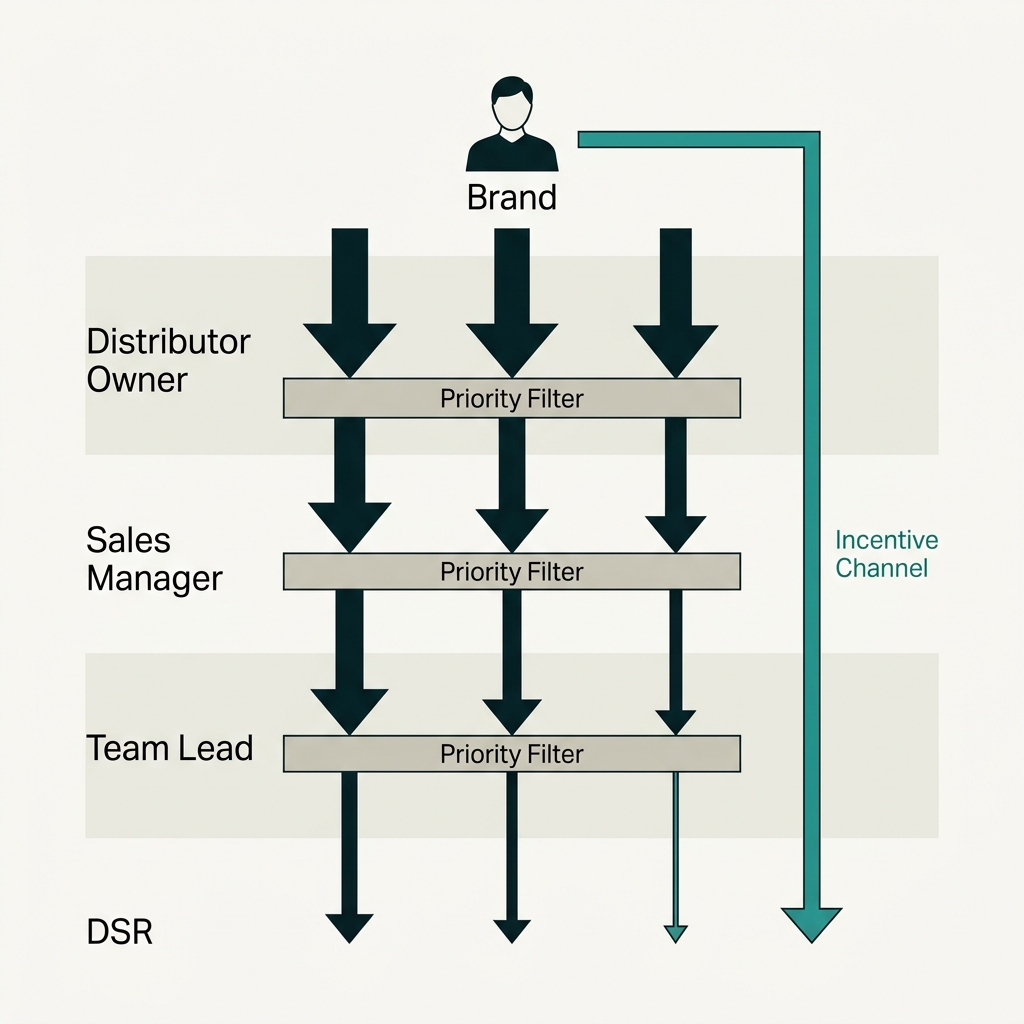
Every FMCG brand has experienced the following pattern. A new SKU is launched with a clear commercial strategy - premium positioning, specific target outlets, a planned pricing architecture, a trade promotion to accelerate initial sell-in. The brand briefs the distributors. The distributors brief their sales managers. The sales managers brief their DSRs. Six weeks later, the brand reviews the launch and finds that the new SKU is at 8% distribution instead of the planned 35%. Competitor SKUs with similar economics but different commercial importance to the distributor are at 40%. The brand's commercial team is frustrated. The distributors make polite excuses about market conditions. Nobody in the conversation acknowledges the actual problem, which is that the distributor owner's priorities do not align with the brand's priorities, and the DSR has been briefed accordingly.
This is not a failure of the distributor relationship. It is a structural feature of the distribution model. The distributor owner makes rational decisions based on their own P&L. If your new SKU has a 22% margin and a competitor's comparable SKU has a 28% margin, the distributor owner will rationally prioritise the competitor's SKU - unless the volume differential is large enough to offset the margin difference. The DSR, receiving their brief from their team lead, who received it from the sales manager, who received it from the distributor owner, will pitch what they have been told to pitch. The brand's strategic priorities do not reach the DSR in a form that overrides the distributor's prioritisation logic.
The political economy of distributor influence
FMCG brands spend significant resources trying to influence DSR behaviour from headquarters. They run DSR training programmes. They produce DSR-facing marketing materials. They fund regional DSR conferences. They structure volume-based incentives that reward distributors for pushing specific SKUs. Each of these interventions routes through the distributor owner, and each is filtered - intentionally or otherwise - by the distributor owner's own commercial priorities. The brand's message reaches the DSR only in the shape the distributor allows it to reach the DSR. This is not bad faith. It is how the hierarchy works.
The consequence is that brands have no direct channel of influence to the individuals who actually execute their commercial strategy. The DSR is physically present at the moment of truth - standing in front of the outlet owner, with the order in their hand - and the brand has no mechanism to reach them at that moment with a signal that carries more weight than their team lead's brief from the morning. This is structurally asymmetric. The distributor owner can direct the DSR. The sales manager can direct the DSR. The team lead can direct the DSR. The brand, which is paying for all of this, cannot direct the DSR. And the DSR, rationally responding to the only incentive structure that affects their paycheck, optimises for what the distributor wants, not what the brand wants.
The architectural fix - a direct incentive channel
The fix is to open a direct incentive channel between the tenant (the brand) and the DSR. Not a replacement for the distributor's relationship with the DSR - that relationship has to remain intact, because the DSR is the distributor's employee. But a parallel incentive channel, configured by the brand, that rewards specific DSR behaviours the brand wants to see, without routing through the distributor's prioritisation logic.

The mechanics are simpler than most brands assume. The DSR is already a known identity in the platform - they have a user account, a GPS-verified visit history, a structured record of their orders and refusals. The platform can evaluate any incentive rule against that record automatically. When the brand configures a rule - "earn a bonus for every new outlet that accepts a first order of the new synthetic SKU" - the rule fires every time the ground-truth data matches the condition. The DSR sees the earned bonus in their app in real time. The distributor owner sees the aggregate payout at the end of the period but does not control it.
Configurable settlement
The one design decision that makes this workable in practice is configurable settlement. Some tenants will want to pay the DSR directly, bypassing the distributor entirely. This maximises the incentive's motivational power but can create political friction with the distributor. Other tenants will want the distributor to pay the DSR, with the tenant reimbursing the distributor for the bonus amount. This preserves the distributor's relationship with their employee but ensures the incentive lands on the behaviour the brand wants. Some tenants will want the incentive to be purely motivational - recognition-based, not financial - with the distributor free to honour the recognition or not. The platform supports all three models as tenant-level configurations, and the choice becomes a contractual matter during the JBP negotiation, not a technical constraint.
The engineering is straightforward because the underlying ledger architecture is the same for all three settlement models. The promotion defines the rules, the event stream evaluates them, the ledger accumulates the earnings, and the payout export file is generated at period close with the settlement method applied. What changes between models is who receives the payout file and how the money flows. The rule evaluation, the ground-truth validation, and the auditability are identical.
The trigger events that matter
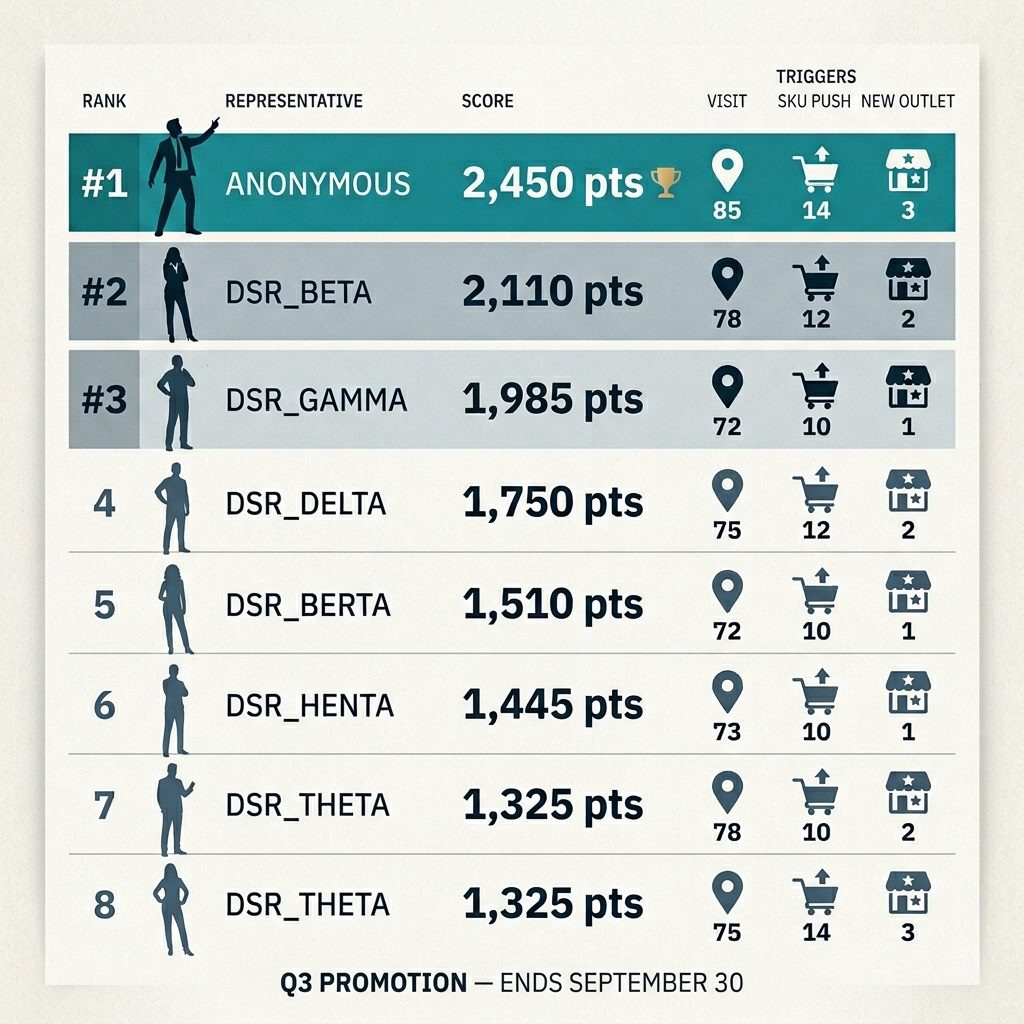
The DSR incentive engine is only as valuable as the trigger events it can read. Fortunately, a well-designed field execution module generates exactly the right trigger events for this purpose. GPS-verified visit count rewards attendance consistency. Visit checklist scores reward quality, not just quantity. SKU-specific push conversion rewards the DSR for successfully placing the strategic SKU. New outlet acquisition via the SPANCO pipeline rewards business development activity that expands the brand's coverage universe. Refusal capture compliance rewards the intelligence contribution the DSR is making, not just the transactional output. Each of these is a structured event with GPS, timestamp, and outlet-level provenance, and each can be targeted by an incentive rule with a specific weight.
This means the brand can configure, for example, a Q3 promotion that rewards the DSR with three points for every new outlet that accepts the new synthetic SKU, one point for every existing outlet that adds the new SKU to their order, and half a point for every structured competitor price observation captured during a visit. The configuration is specific to the brand's Q3 commercial objectives. The leaderboard closes at quarter-end, the payout settles in the configured way, and the brand has a documented outcome - measurable change in DSR behaviour, attributable to a specific incentive, with a specific ROI.
Why this is a genuine superpower
Most FMCG brand conferences have a panel where the Chief Commercial Officer talks about "the challenge of driving distributor alignment." It is the same panel, with slightly different language, at every conference. The challenge is real, and it has been the same challenge for thirty years. The reason it has been unsolved for thirty years is that the brand has been trying to solve it at the distributor level - through margin structures, volume incentives, contract terms, and relationship management - when the actual point of influence is at the DSR level, and the brand has historically had no way to reach the DSR directly.
The platform opens that channel. It does not replace the distributor relationship. It adds a second relationship, one that routes directly from the brand's commercial intent to the DSR's daily behaviour, validated by ground-truth data, settled transparently. Brands that use this channel well will shift DSR behaviour in ways that their competitors, still working through the distributor filter, cannot match. Over time, the brands that build direct DSR relationships - through incentives, through pre-visit intelligence, through recognition programmes - will have structurally better field execution than the brands that still rely on distributor briefings to move their commercial strategy through to the shelf. This is the superpower. It is not a marketing term. It is a measurable capability difference, and the brands that deploy it first will compound the advantage before the rest of the industry understands what has happened.