The most valuable architectural decision in a multi-tenant SaaS platform is often invisible to the end user, rarely discussed in product marketing, and almost never understood by buyers during an evaluation. It is the decision to separate the way the platform sees the world from the way each client sees the world - and to map between them through an explicit layer that serves as the foundation for cross-tenant learning. When this layer exists, the platform gets smarter every time a new client joins. When it doesn't, each new client is a reset to zero, and the platform is permanently stuck at the intelligence level of its first customer.
Most SaaS platforms do not have this layer. Their schema uses the first client's vocabulary. When the second client arrives with different terminology, the platform either forces them to adopt the first client's language (which breaks adoption) or adds a free-text display label (which satisfies the user but strands the underlying data). Either path sacrifices the compounding benefit of cross-tenant pattern recognition. This article is about what the right architecture looks like and why it matters disproportionately for platforms serving distribution networks across industries.
The terminology problem is real
An outlet in the lubricants industry is a workshop - a motorbike service centre, a quick-lube bay, a truck fleet depot. An outlet in personal care FMCG is a convenience store, a supermarket, a pharmacy. An outlet in food and beverage is a restaurant, a café, a canteen. These are structurally similar distribution targets - all are businesses that sell the brand's product to an end consumer - but the client's commercial team uses completely different vocabulary to describe them, classifies them through different tier structures, and measures their success with different metrics.
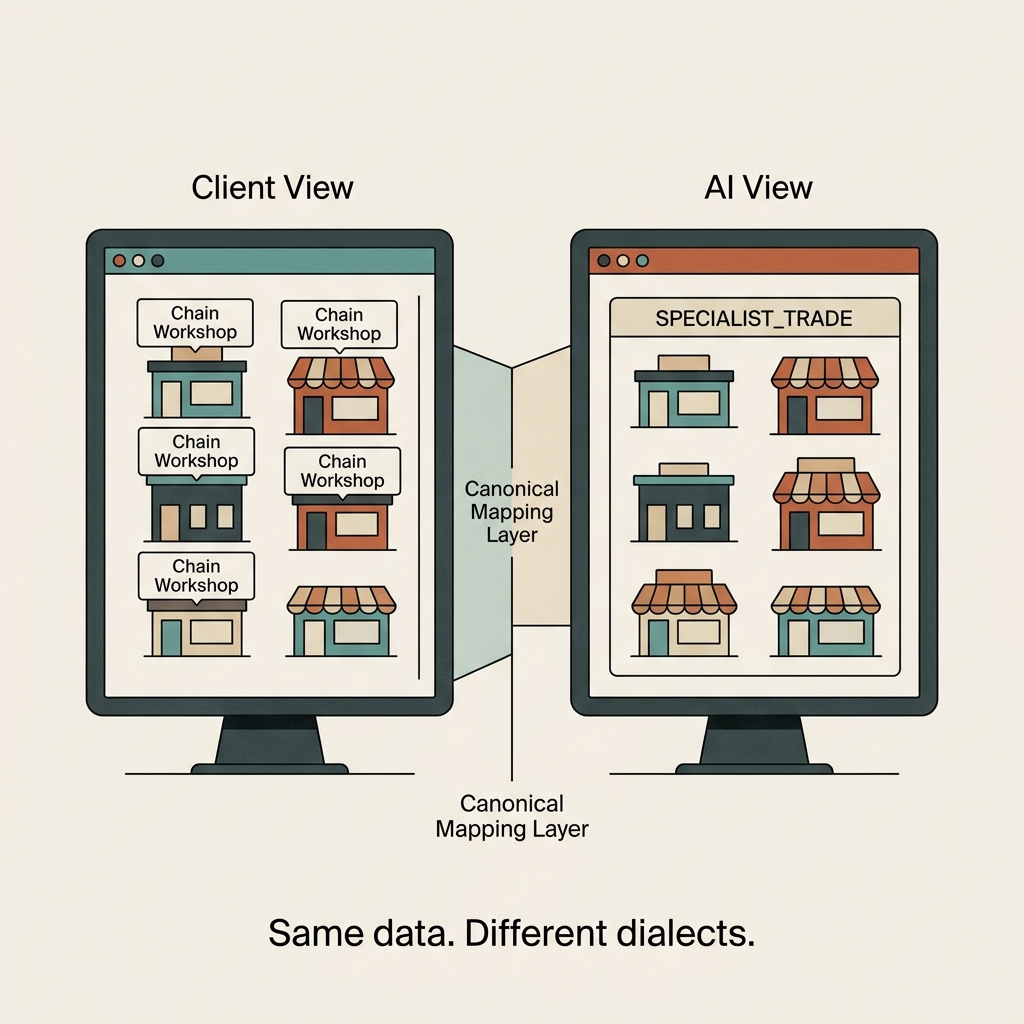
A platform that wants to serve all three industries faces a design choice. Option one: pick one vocabulary and force everyone to adopt it. This is what most B2B SaaS platforms do because it is the simplest build. The consequence is that the personal care client sees "workshop" in their platform view and loses confidence that the platform understands their business. Option two: let each client define their own vocabulary. This is what many platforms end up doing as a compromise. The consequence is that the AI, the benchmarks, and the cross-tenant learning all reset at the client boundary because the underlying data is in different dialects. Option three: build a canonical mapping layer. This is what the right architecture does. The AI sees a canonical archetype - MODERN_TRADE, TRADITIONAL_TRADE, SPECIALIST_TRADE, WORKSHOP_NETWORK, ECOMMERCE_PLATFORM, and so on. Each client sees their own industry-appropriate display labels. The mapping between them is captured during onboarding and maintained as a structured configuration.
How the mapping actually works
When a new lubricants tenant onboards, their implementation team configures a simple mapping: the client's term "Chain Workshop" maps to the platform's canonical archetype SPECIALIST_TRADE. Their term "Independent Mechanic" maps to TRADITIONAL_TRADE. Their term "Fleet Account" maps to a canonical archetype used across industries for large-volume direct buyers. This mapping is a one-time setup. Once it is in place, every piece of data the tenant generates - every outlet record, every visit, every order, every refusal - carries both the client display label and the platform canonical archetype. The client's team sees "Chain Workshop" on every screen. The platform's AI sees SPECIALIST_TRADE.

The second lubricants tenant joining a year later has a nearly identical setup. Their term "Franchise Service Centre" also maps to SPECIALIST_TRADE. The third lubricants tenant's "Authorised Workshop" - same mapping. Within three or four tenants in a category, the platform has accumulated a canonical benchmark for SPECIALIST_TRADE channel performance that is statistically meaningful - average visit frequency, SKU distribution patterns, typical refusal reasons, conversion rates by promotion type. When the fourth tenant onboards, their system is not starting from zero. Their SPECIALIST_TRADE channel benchmarks are pre-populated from the canonical data, adjusted for market-specific factors captured in the onboarding assessment.
The same applies to SKU categories, distributor types, DSR role definitions, promotional mechanics, and every other dimension where industry terminology varies but underlying structure is shared. Over time, the canonical dataset becomes the most valuable asset the platform owns - because it is structurally impossible for a competitor to replicate without running the same tenant base through the same ingestion pipeline for the same length of time.
The moat is the asymmetry
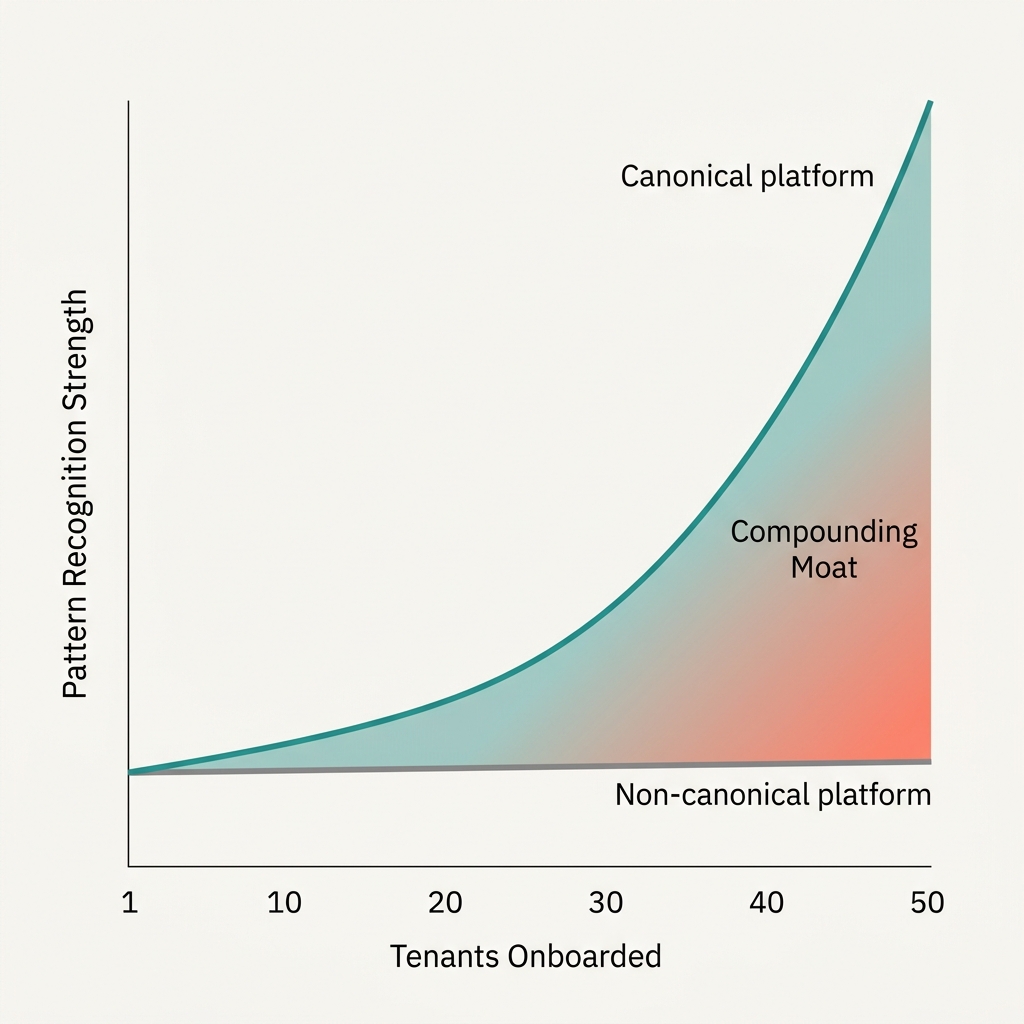
This is the moat that most SaaS business models describe but few actually build. The conventional SaaS moat story is network effects - more users, more data, better product. The story is usually true at the marketing level and false at the architectural level, because most SaaS platforms do not have the canonical mapping layer that lets cross-tenant data actually reinforce learning. Without the mapping, more users produces more siloed data. With the mapping, more users produces more pattern recognition.
The asymmetry grows with time. A platform that onboards its tenth tenant with a canonical layer has roughly ten times the pattern-recognition strength of a platform that onboards its tenth tenant without one. By the fiftieth tenant, the gap is qualitatively different - the mapped platform can predict outcomes, recommend interventions, and benchmark performance in ways the unmapped platform simply cannot. A competitor arriving late cannot close the gap by building the canonical layer after the fact, because retrofitting a mapping across a non-canonical historical dataset is architecturally painful and almost always incomplete. The canonical decision has to be made on day one of platform design, and most platforms do not make it.
The client-visible consequence
From the client's perspective, the canonical mapping is invisible in a very specific way. They see their own vocabulary on every screen. Their reports use their own terminology. Their dashboards reflect the way they run their business. The platform feels native to their industry. Behind that native surface, the platform is learning at an accelerated rate from every other tenant operating in the same canonical channels. The client benefits from that accelerated learning - better benchmarks, better recommendations, better predictive accuracy - without ever having to adopt someone else's vocabulary or compromise on how their business is described.
This is what it means for a SaaS product to be truly client-neutral. It is not about being generic. It is about being structurally capable of serving each client in their own language while accumulating intelligence in a shared language underneath. The architectural decision that enables this is small - a handful of tables, a discipline about where canonical IDs are stored versus where display labels are stored, a rule that AI reads canonical and user reads display. The consequence of that decision compounds for the life of the platform.
The currency and language extensions
The same principle applies to currency and language. A tenant-neutral platform cannot assume the dollar or the English language. Currency fields carry an ISO code and a formatting locale per tenant. Numeric displays render correctly for Middle Eastern comma-decimal conventions and Asian grouping conventions. Language preferences live at tenant, role, and user levels. Translation strings live in a structured store - not hardcoded in frontend components. Every one of these decisions is trivial individually and transformative in aggregate. A platform that gets them right at the schema level can onboard a Middle Eastern tenant in Arabic with RTL support in a week. A platform that gets them wrong retrofits them over eighteen months and never quite gets them right.
The commercial implication is expansion velocity. The canonical platform can enter new industries and new geographies without rebuilding its intelligence layer each time. The uncanonical platform cannot. That difference determines whether the SaaS business is a single-industry tool with a natural ceiling or a horizontal operating system with a global addressable market.